
Home Age Fit Addresses Wet-Area Safety and Slip-Resistant Flooring Following New Fall-Risk Research
New York, New York - October 06, 2026 - PRESSADVANTAGE - Home Age Fit, a provider of engineering-informed
Press Release Disclaimer: This is a press release distributed through the XPR Media network. It has not been independently verified by our newsroom.

New York, New York – October 06, 2026 – PRESSADVANTAGE –
Home Age Fit, a provider of engineering-informed aging-in-place design resources, is drawing attention to wet-area home safety as a key environmental factor in household accidents, citing a new peer-reviewed study published September 9, 2026 in BMC Public Health. The research examined 385 adults aged 65 and older in the central district of Kırklareli, Turkey, and found that better wet-area safety was significantly associated with lower odds of an indoor accident (OR 0.11; 95% CI 0.01–0.93; p=0.042).
In the study, 13.0 percent of participants reported an indoor accident and 19.1 percent had a history of falls. The authors concluded that fall and accident risk should be considered in relation to the architectural and environmental characteristics of the home, as well as individual health factors, calling particular attention to wet areas. Because the study is cross-sectional, the finding reflects an association rather than proof that any single modification prevents falls.
The research arrives alongside broader U.S. investment in home modification. The Department of Housing and Urban Development’s 2026 Older Adults Home Modification Grant Program made $64 million available across an expected 32 awards for low-cost, high-impact modifications intended to reduce fall risk, improve accessibility and help lower-income older adults remain at home. Applications closed August 31, 2026.
Home Age Fit uses this moment to clarify a point it considers widely misunderstood: wet-area safety is a system rather than a single labeled product. The company’s framework treats traction as the combined result of flooring finish, documented wet performance, water and cleaner residue, mats, rugs, thresholds and the movement needs of the person using the space.
“The word non-slip is a description, not a measurement,” said Oded Feigin, founder of Home Age Fit. “The recent research identifies wet areas as significant, but it does not hand consumers a flooring-selection framework. A surface only performs when it stays stable while wet, worn or freshly cleaned, and when the entire route holds together rather than one tile in isolation.”
The company notes that maximum grip is not automatically the right answer. Added texture or grout lines can support barefoot traction while making movement harder for a walker or wheelchair, a trade-off detailed in the Home Age Fit Non-Slip Bathroom Flooring Guide. Surface continuity, seam height and flush transitions therefore matter as much as raw friction.
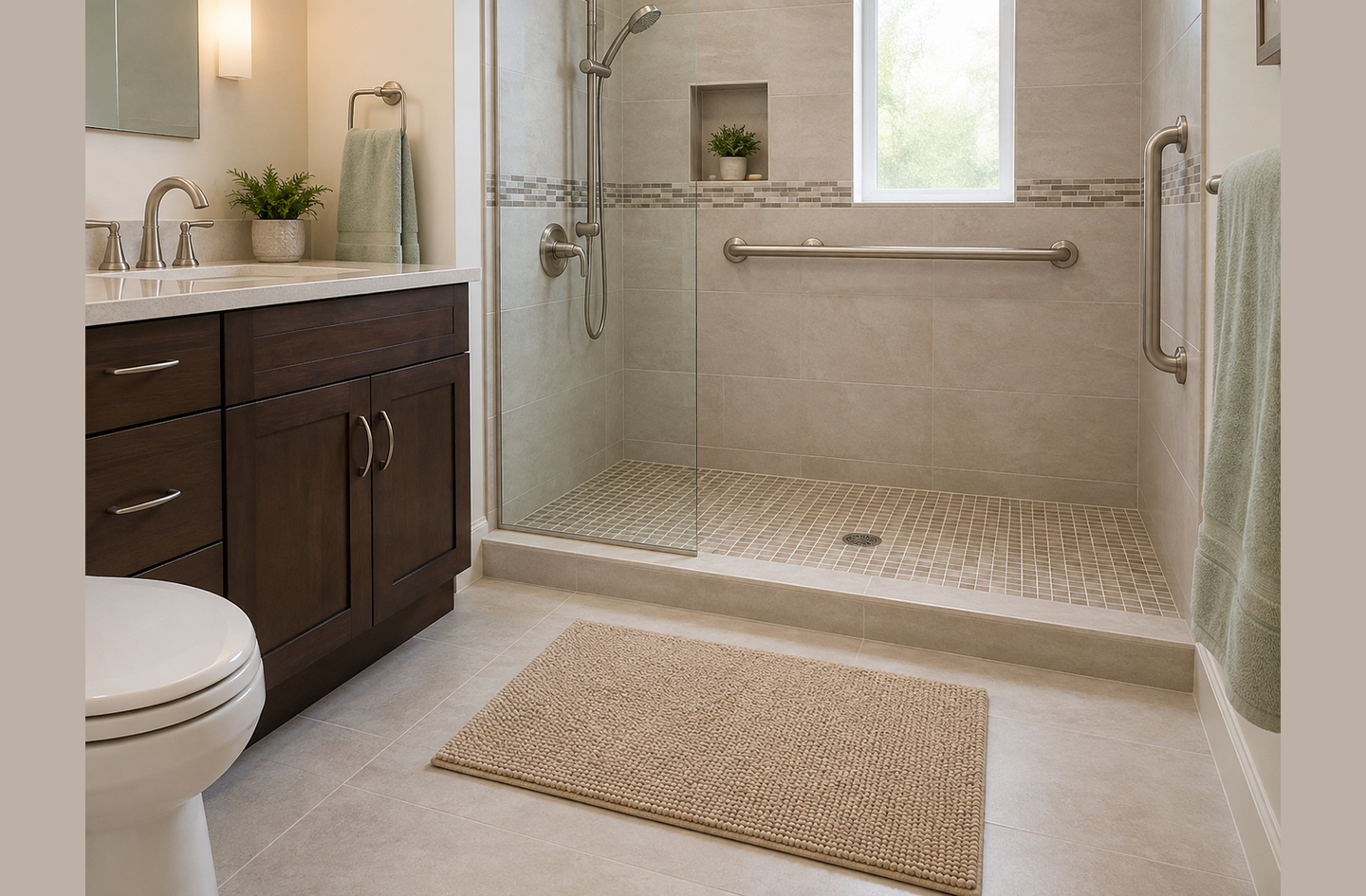
“A bath mat cannot be judged apart from the floor it sits on,” Feigin added. “Suction cups need a smooth, non-porous surface, so texture and grout can undermine the seal. Coverage, drainage, backing and edge behavior all belong in the decision.”
These considerations are addressed in the Home Age Fit Slip-Resistant Flooring Guide and the Home Age Fit Guide to Non-Slip Bath Mat Grip, which apply documented wet ratings and use classifications rather than marketing terminology. The U.S. Access Board reinforces this approach, stating that accessible surfaces must be stable, firm and slip resistant while noting that no single coefficient-of-friction threshold applies across all test methods.
Home Age Fit creates technical breakdowns, ergonomic frameworks and preventative design resources to help seniors and their families adapt the home for the next phase of life. Led by Oded Feigin, the company applies engineering principles to questions of kinetic flow, environmental control and structural safety.
###
For more information about Home Age Fit, contact the company here:
Home Age Fit
Oded Feigin
info@homeagefit.com
144-42 Jewel Avenue
Flushing, NY 11367
United States


